



The 2026 Finance Act introduces the Standardized Electronic Invoice.
A major reform designed to combat VAT fraud and strengthen public finances.
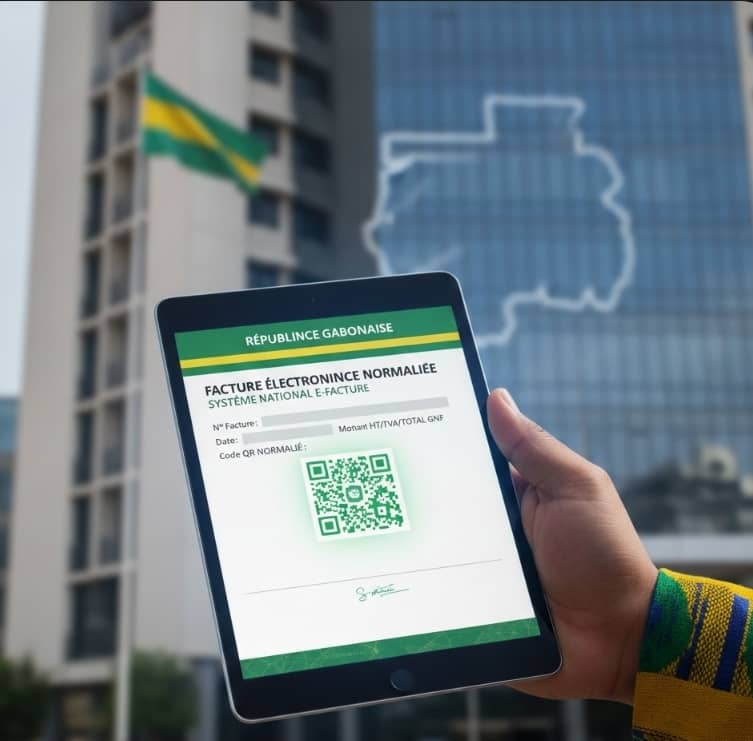
S tarting from the 2026 fiscal year, your business could become illegal… without you even knowing it. A simple sale, a service rendered, a forgotten receipt… and suddenly, you risk a fine equivalent to your entire transaction, or even more. Here is everything you need to know.

Gabon is activating a silent but formidable reform: the standardized electronic invoice is progressively becoming mandatory for all economic players. Behind this decision lies a clear objective: to end opaque practices, track tax evasion, boost public revenue, and regain total control over every franc in circulation. But for companies and traders, the countdown has begun… and the penalties will offer no second chances.
Indeed, starting from the entry into force of the 2026 Finance Act, any commercial transaction carried out by a natural or legal person subject to tax or VAT must be accompanied by a standardized electronic invoice. This invoice must be issued using a billing device approved by the General Directorate of Taxes (DGI), in accordance with Decree No. 0536/PR of December 29, 2025.
What does this actually mean? This invoice is no longer just a simple commercial document: it is becoming a fiscal, legal, and digital instrument, entailing the direct liability of both the seller and the buyer. This reform imposes a radical shift in the management habits of companies, traders, artisans, service providers, and self-employed professionals. From now on, no sale, service, or purchase can be legally recognized without this electronic invoice, which becomes the sole valid proof of transaction in the eyes of the tax administration.
The standardized electronic invoice must include a strict set of information, notably: the tax identity of both the supplier and the customer, a precise description of the goods or services, quantities, unit and total prices, applicable taxes, and the VAT amount. Buyers themselves are also being called upon: they are now obligated to demand this invoice for every transaction. Failure to do so will result in the loss of their right to VAT deductions and the inability to record the corresponding expense in their taxable income.
The penalties provided are particularly severe. Any sale made without a standardized invoice, any under-invoicing, or the issuance of non-compliant documents exposes the offender to a fine equivalent to 100% of the transaction amount, with a minimum of 200,000 FCFA. An incomplete or incorrect invoice results in a fine of 50,000 FCFA. Any other violation of the regulations is punishable by a fine of 1 million FCFA.

Furthermore, when a company is managed by foreign nationals, a ban from residing in Gabon may be issued, in addition to financial penalties, upon the decision of the Minister of Finance.
Behind this reform, the State is pursuing a strategic objective: to clean up the fiscal environment, secure public revenue, and effectively combat VAT fraud.
The Ministry of Economy, the DGI (General Directorate of Taxes), and their technical partners have already finalized the digital invoicing application. A testing and deployment phase for pilot taxpayers is scheduled before the end of the first quarter of 2026, marking the beginning of a new era in fiscal governance.
One thing is now certain: in 2026, transparency becomes the rule, invoicing goes digital, and fraud becomes a major risk.